
The Lancet Fluke: Evolution at its most appalling.
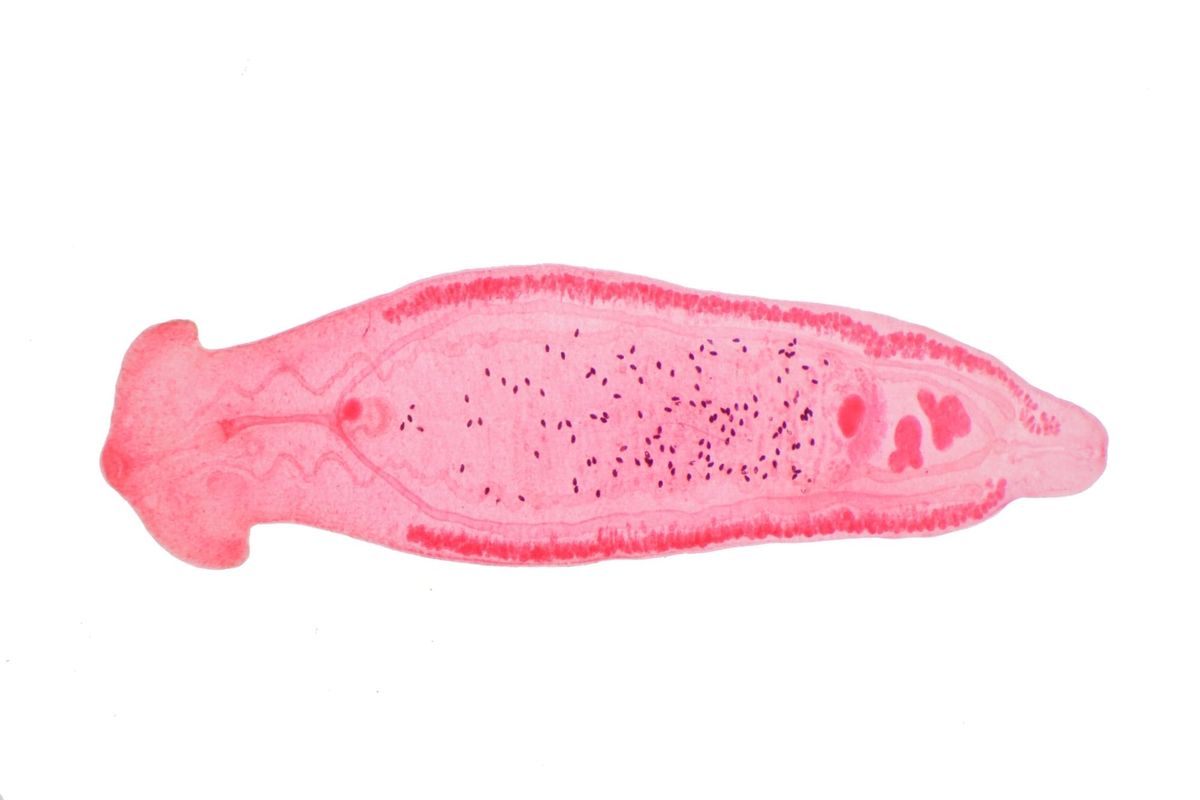
The Lancet Fluke (Dicrocoelium dendriticum) wants to spend its adult life in a sheep's liver. Getting there is quite a journey.
Its eggs leave the sheep in the droppings, and a snail eats them. The larvae bore out through the snail's gut. The snail does what it can to defend itself, walling the parasites into cysts and leaving them behind in slime trails on the grass.
Along comes an ant, looking for moisture. It swallows a cyst packed with young flukes, and at least one of them reaches the ant's nervous system and takes the controls.
As the evening cools, the ant leaves its colony, climbs to the top of a blade of grass, clamps its jaws shut and waits. At dawn it lets go and goes back to being a perfectly normal ant, because the sun would kill it and the parasite with it. Night after night, the same routine, until a sheep eats the grass and the ant along with it. The flukes are home, and the cycle starts again.
Three things strike me.
1. The awe. If you accept evolution by natural selection, as I do, you have to stand in awe of what it can produce: the strangest creatures, with the most elaborate behaviour, and no designer required.
2. The puppet. Evolution doesn't just shape bodies, it wires in behaviour, and behaviour can look like a decision when it isn't. The ant seems to have chosen to climb that blade of grass. It hasn't. The instructions come from the fluke's genes, reaching out into another animal's behaviour. We humans like to think we have free will, but I wouldn't underestimate how much of what we do is coded in.
3. The designer. If you'd rather believe in a God who designed all this, what sort of God dreams up the Lancet Fluke? Darwin had the same problem with parasitic wasps that lay their eggs inside living caterpillars. He couldn't believe a kind and all-powerful creator would have designed that on purpose.
Food for thought?